✿ Last updated: 21 Jul '26 ✿
Domain
Agentic sales
Duration
3 Weeks (🚩)

We redesigned campaign creation to make it instant, reusable, and scalable, reducing friction from a multi-step flow to a near one-click experience.
Our v1 that worked, but not how users actually wanted.
We had already shipped an AI-first campaign creation journey. But post-launch feedback revealed a gap between the experience we designed and the behaviour users expected.
I spoke with the sales team to understand where v1 broke down and what slowed them down.
What v1 got right
AI drafts were strong - removed the blank-page problem, users trusted the output.
Wizard kept users oriented - leads, sequence, and messaging connected end-to-end.
Progress visibility reduced anxiety - users always knew where they stood.
Guardrails prevented incomplete launches -structure that protected quality.
Where it broke down
Campaign as the primary object felt heavy. SDRs had to configure everything upfront before seeing any value.
Leads were a dependency SDRs didn't own, came from managers later, turning mid-flow blocks into abandoned drafts.
Decision fatigue across every step… channel, delay, sender, schedule all empty, all required, all adding up.
Mental model mismatch - SDRs think in reusable systems, not one-time launches.
We didn't audit competitors, we studied the two tools our sales team already loved, to understand what made their experience feel effortless.

Template library as the entry point → users start faster when they begin from something proven.
Visual step builder → channel, delay, type scannable at a glance without opening anything.
No AI in writing → users still drafted every message manually.
No defaults → every sequence started from zero configuration.
Scannable multi-step builder → confirmed the pattern was worth replicating.
Sequence setup decoupled from contact addition → validated the direction we were already considering.
AI felt bolted on → it assisted but didn't lead, users still drove every decision.
Still too heavy for SDRs wanting to launch fast → too many choices before reaching value.
If we shift from campaign creation to reusable sequences, SDRs can set up once, keep adding leads, and focus on selling, not configuring.
Before we made actual design efforts, we used Figma Make and iterated till we get close to what we actually wanted.
✅
Let the product team validate assumptions and lock in requirements.
✅
Gave the dev team early visibility into scope and technical constraints.
✅
Avoided costly revisions by iterating fast before any real design effort.
Shifting to sequences meant rethinking control, decisions made with the product team, each deliberate, each with a tradeoff we accepted.
Decision 01: Configured by default - trusting AI over user control
Problem
Every empty field was a drop-off risk. Users weren't exercising control, they were leaving because of it.
Cost
Removing explicit control meant we were making decisions on behalf of the user. Power users who wanted intentional configuration now had to actively undo defaults rather than build deliberately from scratch.
Decision
The data was clear: users weren't exercising that control, they were abandoning because of it. A well-considered default is more empowering than an empty field. We bet on speed and confidence over configurability.
Decision 02: Decoupling leads - flexibility over completeness
Problem
SDRs had intent but not leads yet. Blocking them on a dependency they didn't own caused the most drop-off in v1.
Cost
A sequence could sit fully configured but never activate. We moved the guardrail to activation, a dashboard prompt that fires when it's actually useful.
Decision
Flexibility at creation beat enforced completeness that nobody completed. The draft graveyard proved that blocking users early didn't make them more prepared, it just made them leave.
I introduced a dedicated Sequence tab so users weren't forced to abandon the familiar campaign structure, a low-friction entry point that didn't discard existing mental models
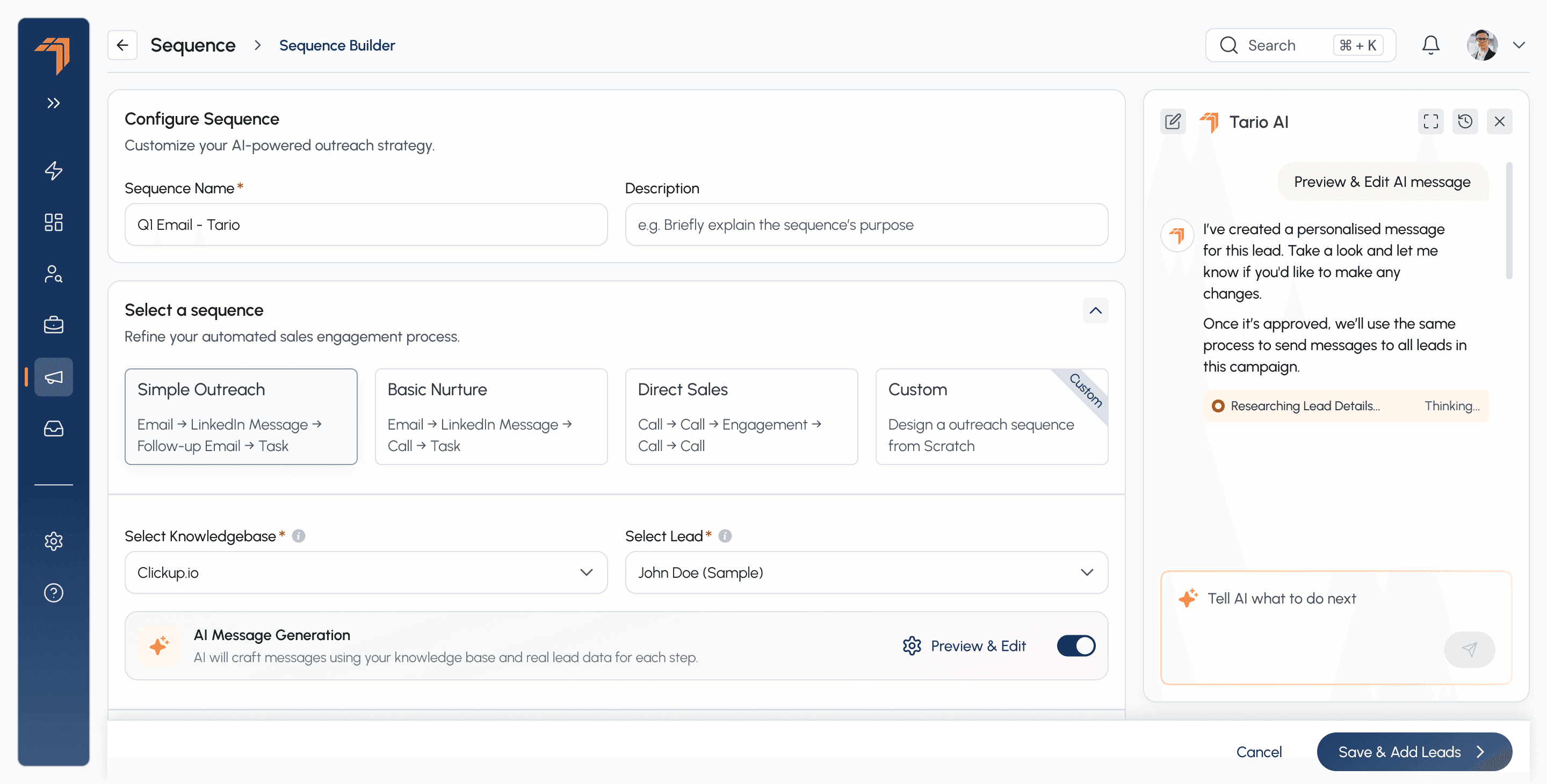
SDRs could start with just a name and a template , Simple Outreach, Basic Nurture, Direct Sales and the entire outreach strategy was pre-configured and ready to run.
AI was defaulted to the primary knowledge base with messages pre-drafted per step and settings pre-filled, no empty fields, no decisions required to get to launch.
I designed a direct prompting experience so users could adjust tone, guide research, and specify data points, without leaving the creation flow.
I surfaced research sources and lead data points alongside every draft so users could see exactly how each message was personalised, building trust in AI output, not just reliance on it.
Preview & Edit was kept as an optional layer, the default experience stayed fast, control was always one step away.
Lead addition was decoupled from sequence creation entirely, SDRs could set up first and add leads when ready, removing the biggest drop-off point from v1.
I designed a natural language search so users could describe their target audience in plain terms, AI applied the right filters automatically, no manual configuration needed.
Users could review, adjust filters, and confirm before saving, the sequence activates on their terms, not the product's.
We considered the side panel to keep AI editing in one place, but it conflicted with the primary AI assistant, making shared history and context messy.
The panel felt right for quick edits, but message crafting needed more space and focus, so a modal was the better fit.

Measured after 2 weeks in production
⬅️ 10s
Campaign creation time, down from several minutes
⬆️ Reuse
Increase in repeat sequence usage
⬇️ Drop-off
Fewer users abandoning min-setup
⬆️ CSAT
Improved perceived easy of use
This case study offers a glimpse, we’ve built over 10+ modules and 30+ features in Tario, shaping the future of UX and collaboration between users and agents.
If you’d like to know more, feel free to connect at amandzn.work@gmail.com